

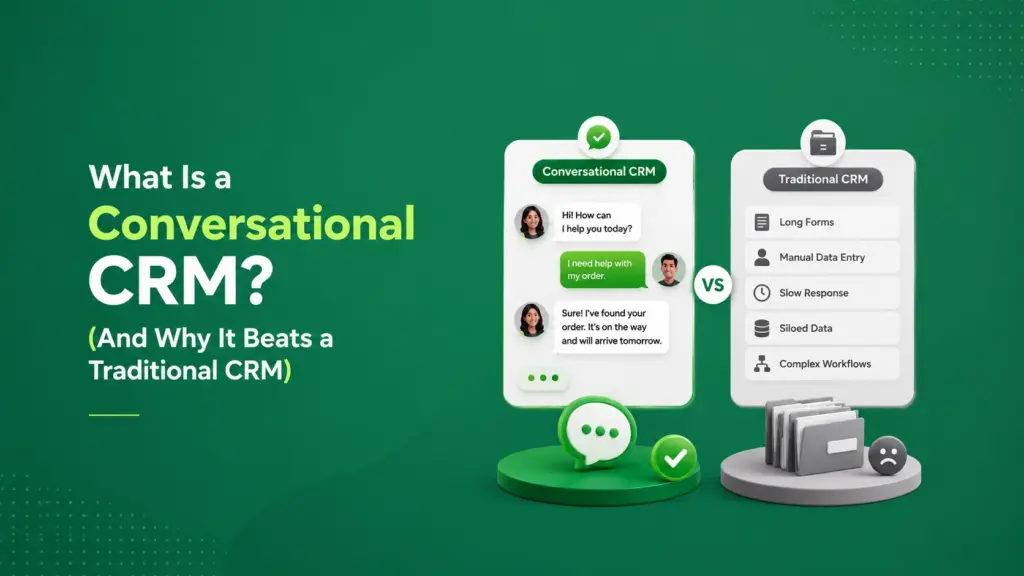
Traditional CRMs were built for a world of phone calls and spreadsheets, where a salesperson logged activity after it happened. But today, most customer relationships actually live inside conversations — WhatsApp threads, Instagram DMs, live chats, emails. A conversational CRM is built for that reality.
This guide explains what a conversational CRM is, how it differs from a traditional CRM, the benefits, and how to tell if your business needs one.
What is a conversational CRM?
A conversational CRM is a customer relationship management system built around real-time messaging. Instead of treating conversations as something you log separately, it makes the conversation itself the center of the record. Every chat across every channel automatically feeds the customer’s profile, pipeline stage, and history.
In short: a traditional CRM stores data about conversations. A conversational CRM is the conversation, with the CRM built in.
Conversational CRM vs traditional CRM
| Aspect | Traditional CRM | Conversational CRM |
|---|---|---|
| Core unit | Records and fields | Live conversations |
| Data entry | Manual logging after the fact | Automatic from every chat |
| Channels | Often email/phone-centric | WhatsApp, Instagram, SMS, chat, email — unified |
| Response speed | Slower, batch follow-ups | Instant, often AI-assisted |
| Best for | Structured, long sales cycles | Fast, messaging-driven sales |
Neither is “better” in the abstract — but if your customers prefer to message you, a conversational CRM removes the friction that traditional CRMs create.
Why a conversational CRM beats a traditional CRM for messaging-driven businesses?
1. No more manual data entry
Reps hate logging activity, and they often skip it, leaving your CRM full of gaps. A conversational CRM captures every interaction automatically because the conversation is the data.
2. Full context in one place
Every channel feeds one profile, so anyone on your team can see the entire relationship at a glance. This is the payoff of omnichannel communication applied to your CRM.
3. Speed that wins deals
Because it’s built on live messaging, you can respond — or let an AI sales agent respond — in seconds. Faster responses consistently convert better.
4. Conversations turn into pipeline automatically
Leads, deal stages, and follow-ups update as conversations progress, so your pipeline reflects reality without busywork.
5. Automation built in
Follow-up sequences, reminders, and qualification run automatically, so leads don’t go cold while someone “gets around to it.”
What to look for in a conversational CRM?
- Unified inbox across all your messaging channels
- Automatic contact and pipeline updates from conversations
- AI agents that qualify leads and book meetings
- No-code automation for follow-ups and workflows
- Analytics that tie conversations to revenue
If you’re weighing specific products, see our buyer’s guide to AI chatbot and conversational CRM tools.
Does your business need a conversational CRM?
You’re a strong candidate if:
- Most of your customer conversations happen over messaging apps
- Your team forgets to log activity in a traditional CRM
- Leads slip through the cracks because follow-up is inconsistent
- You’re juggling separate tools for chat and for your pipeline
- Speed of response is a competitive advantage in your market
If you’re still tracking leads in a spreadsheet, our guide on how to track leads (spreadsheet vs CRM) is a good next read.
Turn conversations into revenue with TextCRM
TextCRM is a conversational CRM built for exactly this: a unified inbox across WhatsApp, Instagram, Messenger, Telegram, email, SMS, and live chat; AI sales agents that qualify and close; automatic pipeline tracking; and no-code automation — all in one platform. No manual logging, no scattered tools, no cold leads.
Ready to make your conversations work for you? Start a free 14-day trial (no credit card required) or view pricing.
Frequently asked questions
1. What is a conversational CRM in simple terms?
It’s a CRM built around live messaging. Instead of manually logging interactions, it automatically captures every conversation across channels and updates your contacts and pipeline in real time.
2. How is a conversational CRM different from a traditional CRM?
A traditional CRM stores records you update manually and is often email- or phone-centric. A conversational CRM centers on real-time chat across channels and updates itself as conversations happen.
3. Is a conversational CRM good for small businesses?
Yes — especially small teams whose customers message them on WhatsApp, Instagram, or live chat. It reduces admin, speeds up responses, and prevents leads from being forgotten.
4. Can a conversational CRM replace my existing CRM?
For messaging-driven businesses, often yes. If you have complex, long enterprise sales cycles, you may run both — but many teams consolidate into a single conversational CRM to remove tool sprawl.
Discussion